
5A CareVoice
A privacy-focused speech-to-report workflow for home-care nurses and care assistants, with local processing, structured AI and human final review.
At a glance
- Project type
- Client project
- Year
- 2025
- Project stage
- Completed
- Role of 5A Technologies
- Design and implementation of the mobile speech workflow, backend processing, validation, integration, monitoring and controlled release management.
- Technologies
- .NET MAUI
- ONNX
- SQLCipher
- ASP.NET Core
- Azure API Management
- Azure Service Bus
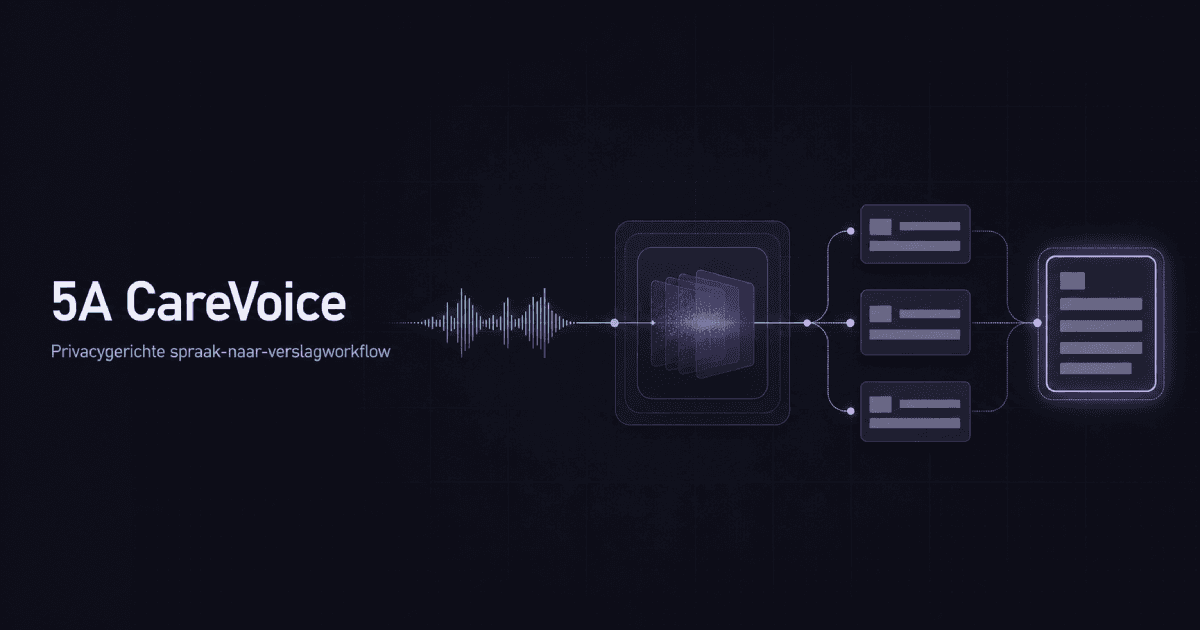
CareVoice workflow in which a spoken care report is transcribed locally, identifying data is minimized, AI structures a draft report, and a nurse reviews the content before transfer. 1. Dictate report: Care and observations after the visit 2. Transcribe locally: Raw audio remains on the device 3. Minimize data: Identity is removed locally 4. Process securely: Only minimized text continues 5. Structure draft: Bounded AI fills a fixed template 6. Validate deterministically: Sources, medication and units are checked 7. Review content: A nurse reviews content and exceptions 8. Transfer with control: Approved draft goes to nursing software Connections: Dictate report to Transcribe locally (speech recording). Transcribe locally to Minimize data (local transcript). Minimize data to Process securely (minimized text). Process securely to Structure draft (bounded processing). Structure draft to Validate deterministically (structured draft). Validate deterministically to Review content (validated draft). Review content to Transfer with control (human approval). Validate deterministically to Review content (uncertainty or missing information).
Dictate reportCare and observations after the visit
Input and handoffThe visit is recorded immediately on the mobile deviceThe nurse dictates delivered care and observations. CareVoice makes no medical decision and does not link a patient record at this stage.
Transcribe locallyRaw audio remains on the device
Deterministic processingSpeech is converted into text locallyRaw audio, speech recognition and the initial quality check remain on the device. After successful transcription, the audio can be removed in accordance with the configured process.
Minimize dataIdentity is removed locally
Deterministic processingIdentifying data is minimized before processingDirectly identifying data is detected and removed locally. Identity is not passed to the language model.
Process securelyOnly minimized text continues
Deterministic processingThe backend receives only the bounded transcriptThe minimized text is processed securely and idempotently. Temporary failures can be retried without creating duplicate drafts.
Structure draftBounded AI fills a fixed template
Bounded AI structuringAI structures content within a fixed report templateThe model receives no patient record, external websites or autonomous tools. It produces only a structured draft based on the permitted text.
Validate deterministicallySources, medication and units are checked
Deterministic processingFixed rules check content and provenanceA separate validation layer checks source references, medication, dosages, units, negations and possible additions that are not supported by the transcript.
Review contentA nurse reviews content and exceptions
Human reviewA care professional reviews content and exceptionsUncertain or insufficiently supported information always proceeds to manual review. The nurse selects the correct care record and retains responsibility for the content.
Transfer with controlApproved draft goes to nursing software
Input and handoffOnly an approved draft is transferredAfter human approval, the draft is transferred to the existing nursing software through a vendor API, secure connector or controlled manual route.
Uncertain or missing information always proceeds to human final review.
Project context and scope
5A CareVoice is a privacy-focused speech-to-report workflow developed for a home nursing organization. The solution helps nurses record delivered care and observations immediately after a visit, without allowing AI to make medical decisions.
- Context: home nursing and mobile care documentation
- Project: anonymized client project
- Year: 2025
- Status: 5A CareVoice is running in production
- Role of 5A Technologies: analysis, architecture, mobile development, AI engineering, backend, integration, security, quality control and release management
- Core principles: local processing, data minimization, deterministic validation and human final review
Important design principle
AI supports the preparation of care documentation. The nurse remains responsible for the content, the patient link and the final transfer to the official record.
The challenge
After every patient visit, a nurse must carefully record which care was delivered, which medication was administered, which observations are relevant and which follow-up remains necessary.
This documentation is produced in a mobile working environment. The solution therefore had to combine natural speech input with privacy, offline usability, reliable processing and clear human control. At the same time, it could not replace the existing nursing software, patient selection or medical responsibility.
The central design question was not only how speech could be converted into text, but how that information could flow safely into a useful and reviewable draft report.
The solution in four steps
Local recording and transcription
The nurse dictates the care delivered and relevant observations while the mobile device is stationary. Raw audio is processed locally. Speech recognition and the initial quality check also take place on the device.
Data minimization for AI processing
Directly identifying data is detected and removed locally before text is sent to the backend. Only the minimized transcript is processed further.
Structured AI with fixed controls
AI converts the permitted information into a strictly structured draft. A separate validation layer checks source references, medication details, dosages, units, negations, left-right indications and possible additions that are not supported by the transcript.
Human review and controlled transfer
A draft report is created only after successful validation. The nurse selects the correct patient, reviews the content and decides whether the draft may be transferred to the existing nursing software.
From speech to a controlled draft
Speech recording
local audio processing
local transcription
local detection of identifying data
minimized text
structured AI output
deterministic validation
fixed report template
human review
controlled transfer
This sequence protects the division of responsibilities. Software handles repeatable steps. AI supports bounded interpretation. An authorized care professional reviews the content and any exceptions.
Privacy and data minimization
The architecture deliberately separates three data domains:
- the official patient and billing domain in the existing nursing software;
- temporarily stored draft reports;
- the bounded AI processing of minimized text.
Raw audio is processed locally and removed after successful transcription. Patient identity is not passed to the language model. Temporary drafts are stored in encrypted form and removed after confirmed transfer in accordance with the configured processes.
Technical monitoring is separated from medical content. Transcripts, medication data, patient observations and generated reports are not used as ordinary technical log content.
Privacy by design
Sensitive information is not protected only after the fact. The data flow was designed from the outset to separate identification, processing, temporary storage and transfer.
Bounded AI, no autonomous medical decision
AI has no access to patient records, billing data, external websites or other historical visits. It cannot invoke tools or external APIs independently.
The application:
- does not make diagnoses;
- does not provide treatment advice;
- does not prescribe medication;
- does not change medication schedules;
- does not select a patient;
- does not approve certification or billing;
- does not make autonomous medical decisions.
When information is uncertain, contradictory or insufficiently supported, a regular draft is not released. The nurse instead receives the available transcript and a clear reason why manual review is required.
Offline-first and reliable
The mobile application remains usable when a network is temporarily unavailable. Transcripts and drafts are stored in encrypted form on the device and synchronized later through a controlled process.
Idempotent processing prevents duplicate drafts when a request is resubmitted. Asynchronous processing, retries, controlled reprocessing and dead-letter handling support recovery from temporary failures.
When AI processing is structurally unavailable, manual transfer of the locally available text remains possible. The workflow therefore does not stop completely when one technical component fails.
Integration with existing nursing software
5A CareVoice does not replace the existing nursing software. It acts as a supporting documentation layer for the official patient record.
Depending on the available environment, an approved draft can be transferred through:
- a vendor API;
- a secure local connector;
- a controlled manual transfer.
Patient selection, official record management, certification and billing remain within the existing nursing software and the existing responsibility structure.
Architecture at a glance
The solution combines local mobile processing with bounded cloud services and a secure review process.
Mobile application
.NET MAUI- local ONNX models
- encrypted SQLite storage with
SQLCipher - offline synchronization
- secure authentication and device management
Backend and processing
ASP.NET CoreAzure API ManagementAzure Service BusAzure Container AppsMicrosoft FoundryAzure SQL DatabaseAzure Key Vault
Review and integration
Next.jsTypeScript- secure Windows connector
- vendor API adapters
Microsoft Entra IDMicrosoft Intune
Quality and operations
xUnitPlaywright- API contract tests
- AI evaluations
Azure MonitorApplication InsightsLog AnalyticsAzure DevOps PipelinesBicep
Quality as a release condition
Functional software quality and AI quality are validated together.
The solution includes:
- unit, integration and end-to-end tests;
- API contract tests;
- mobile component tests;
- security and tenant-isolation tests;
- performance and recovery tests;
- regression tests for models and prompts;
- data-redaction tests;
- checks for medication, dosages and negations;
- AI evaluations against a fixed evaluation set.
Releases are blocked automatically when critical privacy, medication, evidence, tenant or quality contracts deteriorate. Application, model, prompt, schema and template versions can be rolled back independently.
Qualitative outcome
5A CareVoice brings local speech processing, data minimization, structured AI, deterministic validation, human review and technical transfer together in one manageable workflow.
The solution automates preparatory transcription, structuring, quality control, temporary storage and transfer. Patient selection, content approval and medical responsibility remain with the nurse.
The project shows how AI can be used in a sensitive operational context without handing the entire workflow over to a model.
Deliberate limitations
5A CareVoice:
- does not replace nursing software;
- does not make medical decisions;
- does not publish insufficiently validated AI output;
- does not select a patient;
- does not approve certification or billing;
- does not use an autonomous AI agent;
- does not claim guaranteed accuracy or error-free processing;
- does not disclose the client's identity.
What this project demonstrates
This project shows how 5A Technologies:
- defines the boundaries of an operational process before selecting technology;
- gives conventional automation and AI distinct responsibilities;
- embeds privacy and human control in the architecture;
- designs mobile, cloud and integration components as one system;
- treats quality, monitoring and rollback as part of the product;
- builds a solution that works with existing software instead of replacing it unnecessarily.
Would you like to discuss a similar solution?
Tell us where your process slows down today or where AI and automation should work together more effectively. We will explore which controlled approach fits.