
AI Vision Quality Control
A locally trained YOLO computer vision model that analyzed supplied imagery to locate and visually mark conforming and non-conforming objects.
At a glance
- Project type
- Client project
- Year
- 2026
- Project stage
- Completed
- Role of 5A Technologies
- Expertise now brought together within 5A Technologies, gained during a professional assignment: dataset validation, image annotation, local YOLO training, evaluation and technical handover.
- Technologies
- YOLO
- Computer vision
- Object detection
- Local GPU training
Eight-stage workflow: receive images, validate images, annotate objects, split the dataset, train the model locally, evaluate detections, process feedback, and test and hand over the model. 1. Receive images: Supplied production images are the source 2. Validate images: Remove unusable, duplicate and unclear images 3. Annotate objects: Bounding boxes and labels are reviewed 4. Split dataset: Separate training, validation and test data 5. Train model locally: YOLO learns to locate and classify objects 6. Evaluate detections: Investigate false positives and false negatives 7. Process feedback: Adjust labels and settings deliberately 8. Test and hand over: Model tested on images and video, then delivered Connections: Receive images to Validate images (supplied images). Validate images to Annotate objects (usable images). Annotate objects to Split dataset (validated annotations). Split dataset to Train model locally (separate dataset). Train model locally to Evaluate detections (model candidate). Evaluate detections to Process feedback (error analysis and feedback). Process feedback to Test and hand over (selected model version). Process feedback to Train model locally (corrected labels and settings).
Receive imagesSupplied production images are the source
Supplied source and handoverThe assignment starts with supplied imagesAnother party supplies the production images. Cameras, capture infrastructure and image acquisition are outside the scope of model development.
Validate imagesRemove unusable, duplicate and unclear images
Dataset preparation and evaluationThe dataset is cleaned manually firstImages are reviewed, and unusable, duplicate or unclear examples are filtered before annotation and training begin.
Annotate objectsBounding boxes and labels are reviewed
Dataset preparation and evaluationRelevant objects receive validated annotationsConforming and non-conforming objects are manually validated and annotated with bounding boxes. The material, process and defect types remain unnamed because of the NDA.
Split datasetSeparate training, validation and test data
Dataset preparation and evaluationThe data is separated for independent evaluationThe validated images and annotations are divided into training, validation and independent test data so that model development and evaluation remain separate.
Train model locallyYOLO learns to locate and classify objects
Local model trainingThe detection model is trained locallyA YOLO-based model is trained locally to locate objects with bounding boxes and classify them as conforming or non-conforming. No exact historical model version is claimed.
Evaluate detectionsInvestigate false positives and false negatives
Dataset preparation and evaluationUncertain and incorrect detections are reviewed separatelyModel candidates are assessed on validation and test images. False positives, false negatives and uncertain detections inform the next adjustment or handover; exact scores remain private.
Process feedbackAdjust labels and settings deliberately
Human feedback and retrainingHuman feedback determines adjustment or retrainingCorrected labels and user feedback are processed. When changes are needed, the workflow returns to local training and validation follows again.
Test and hand overModel tested on images and video, then delivered
Supplied source and handoverThe final model version is technically handed overThe selected model version is tested on images and video frames. The model artifact and required inference configuration are then handed over to another party for further integration.
NDA: the client, material, manufacturing process, defect types and images remain anonymous.
The retraining loop uses corrected labels and user feedback.
Cameras, capture infrastructure and final production integration are outside this assignment.
Project context and scope
This YOLO-based computer vision model was delivered for an anonymized manufacturing organization during a professional assignment. At 5A Technologies, we build on the resulting computer-vision expertise. The model could locate objects in supplied images and video frames and visually mark them as conforming or non-conforming.
The delivery covered dataset validation and preparation, image annotation, local model training, evaluation and technical handover. The cameras, capture infrastructure and final production integration were outside this scope.
- Context: visual quality control in an anonymized manufacturing environment
- Project: professional machine-learning delivery
- Status: completed and technically handed over
- Role of 5A Technologies: carrying forward expertise in dataset validation, image annotation, local YOLO training, evaluation and handover
- Core principles: controlled data, human validation and iterative model improvement
Key design principle
Model quality depended not only on training, but also on manually validated images, consistent annotations and targeted feedback on incorrect or uncertain detections.
The challenge
A computer vision model can learn only from what is visible and correctly labeled in the training data. The supplied image collection therefore first had to be made usable, consistent and representative before reliable model development was possible.
The main considerations were:
- identifying unusable, duplicate or unclear images;
- annotating conforming and non-conforming objects consistently;
- separating training, validation and test data;
- investigating false positives, false negatives and uncertain detections;
- translating feedback into improved labels and a new training cycle.
The solution
Validate the images
The supplied image collection was reviewed and cleaned first. Unusable, duplicate and unclear images were filtered before entering the model cycle.
Annotate the objects
Relevant objects received manually validated bounding boxes and labels. The dataset was then divided into separate training, validation and test data.
Train locally
A YOLO-based model was trained locally to locate objects in the supplied images and classify them as conforming or non-conforming.
Evaluate and refine detections
After each model candidate, incorrect, missed and uncertain detections were reviewed again. When corrections were needed, labels or training settings were adjusted and a new training and validation cycle followed.
How the workflow worked
- Another party supplied the production images.
- Unusable, duplicate and unclear images were filtered from the dataset.
- Relevant objects received manually validated bounding boxes and labels.
- The dataset was divided into separate training, validation and test data.
- A YOLO-based model was trained locally to locate and classify objects.
- Incorrect, uncertain and missed detections were investigated on validation and test images.
- Corrected labels and user feedback informed a new training cycle where needed.
- The selected model version was tested on images and video frames and technically handed over for further integration.
Model output
For each detection, the model output showed:
- where an object was located in the image through a bounding box;
- whether the object was classified as conforming or non-conforming;
- which confidence value was associated with the detection;
- which objects or regions required further human review.
This output supported model evaluation. No exact accuracy, precision, recall or mAP results are claimed as public project facts.
Training and validation results
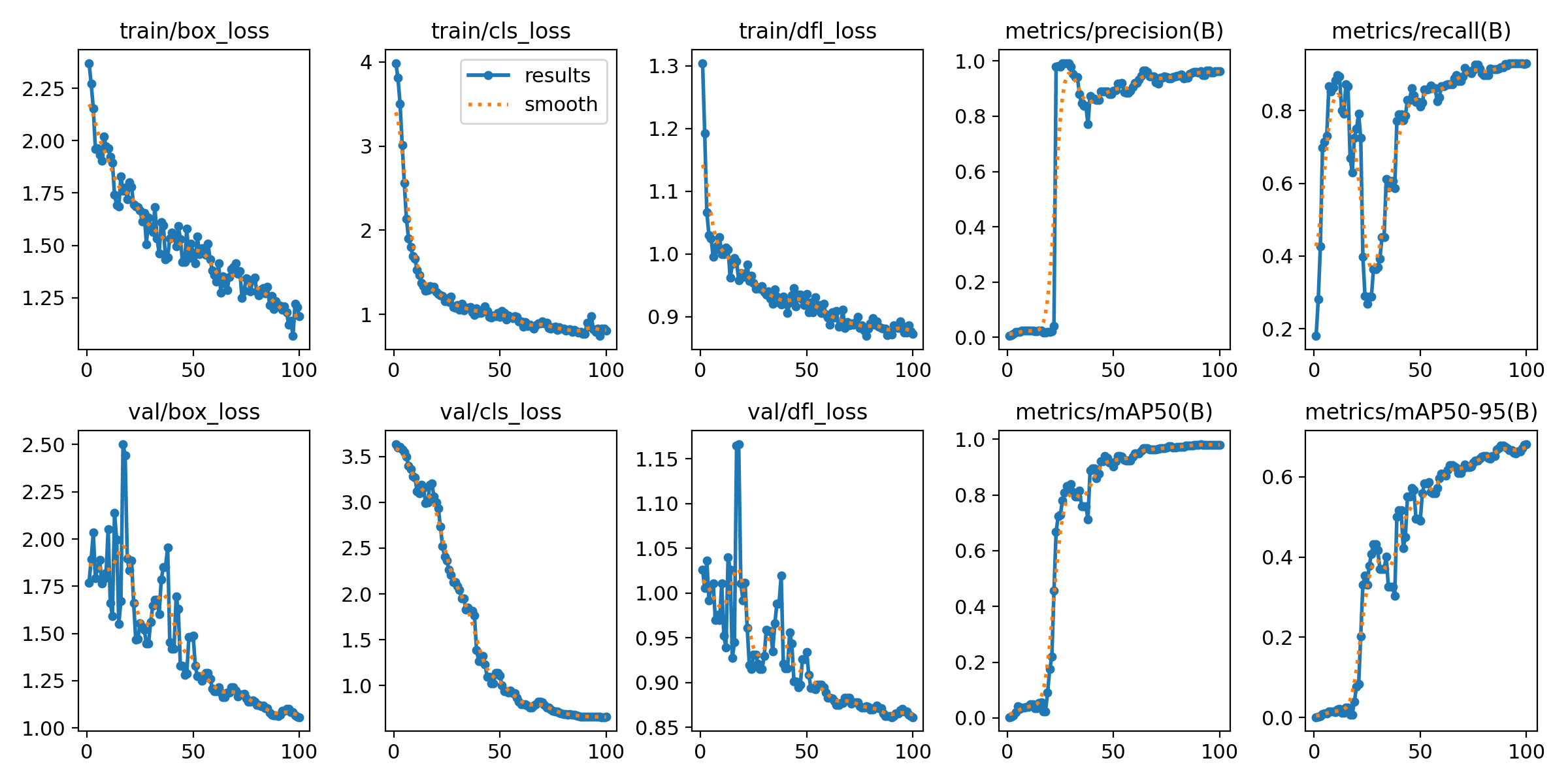
The figure shows the training and validation losses for bounding boxes, classification, and DFL across 100 epochs. The mAP curves for 0.50 and 0.50–0.95 are shown alongside the precision and recall curves. Blue shows the results for each epoch, while the dashed orange line shows the smoothed trend. The decreasing losses and rising, stabilising evaluation metrics indicate convergence within this training run, but do not in themselves provide evidence of production performance.
Technical building blocks
Confirmed core
- YOLO-based object detection: locating and classifying objects in supplied images;
- local model training: running training and validation cycles locally;
- human dataset validation: reviewing images and annotations before they entered the model cycle;
- iterative error analysis: using false positives, false negatives and uncertain detections to adjust labels and settings;
- images and video frames: checking the selected model version on still and moving visual input.
Historical technical reconstruction
The exact historical software versions and full toolchain are no longer confirmed. A plausible technical setup used Python, an Ultralytics YOLO or PyTorch environment, CVAT for annotation, OpenCV for image and video input, and a local NVIDIA GPU with CUDA for training.
These components describe a technical reconstruction, not a separately confirmed product or version contract. Precision, recall, mAP, false positives and false negatives are also relevant evaluation concepts, but no exact measurements are published without the original report.
Human validation and retraining
Human review remained an active part of the model cycle. Incorrect labels, missed objects and uncertain detections could be corrected before the model was retrained.
The workflow was therefore not a one-off straight line. Feedback could return to the dataset and start a new training run, after which the model was checked again on separate validation and test images.
Expertise we bring forward
At 5A Technologies, we build on experience across:
- reviewing and cleaning the supplied image collection;
- validating and annotating relevant objects;
- structuring training, validation and test data;
- training the YOLO-based model locally;
- evaluating incorrect and uncertain detections;
- incorporating user feedback into new model cycles;
- testing the selected model version on images and video frames;
- technically handing over the model artifact and inference configuration.
Qualitative outcome
The project delivered a technically transferable computer vision model that could locate objects in supplied images and video frames and visually mark them as conforming or non-conforming.
The combination of controlled annotations, local training and human feedback made it possible to evaluate and adjust model candidates deliberately before a final version was handed over to another party.
Deliberate publication boundaries
Because of the NDA and the bounded assignment, the public project description observes the following boundaries:
- the client, material, manufacturing process and defect types are not named;
- the original images are not shown;
- the cameras and capture infrastructure fall outside the delivered scope;
- the final production integration is not claimed as a 5A Technologies delivery;
- no exact dataset size or model version is published;
- accuracy, precision, recall, mAP, error rate, comparison with human inspection and operational production results are not presented as confirmed outcomes.
What this project demonstrates
This project shows how a computer vision solution:
- treats dataset quality as a prerequisite for model development;
- embeds human validation in annotation and error analysis;
- deliberately separates training, validation and test data;
- uses feedback to refine labels, settings and new training cycles in a targeted way;
- hands over a model technically without adding unconfirmed production or performance claims.
Would you like to discuss a similar solution?
Tell us where your process slows down today or where AI and automation should work together more effectively. We will explore which controlled approach fits.